

Did you know that it takes an average of 27 interactions before a customer truly trusts your business and decides to buy? In a market saturated with noise, simply having a logo isn’t enough to secure your spot. You probably feel like you are shouting into the void while competitors with professional branding services seem to attract your ideal clients effortlessly.
I am going to help you fix that by breaking down how strategic design and the 5 C’s can transform your identity into a high-value asset. We will explore the roadmap to building lasting loyalty so you can finally stop blending in and start leading your niche.
- Branding Services: Why They Define Your Market Survival
- How the 4-Stage Project Process Actually Works
- The 5 C’s That Make Small Business Branding Stick
- Measuring ROI and Knowing When to Pivot
Branding Services: Why They Define Your Market Survival
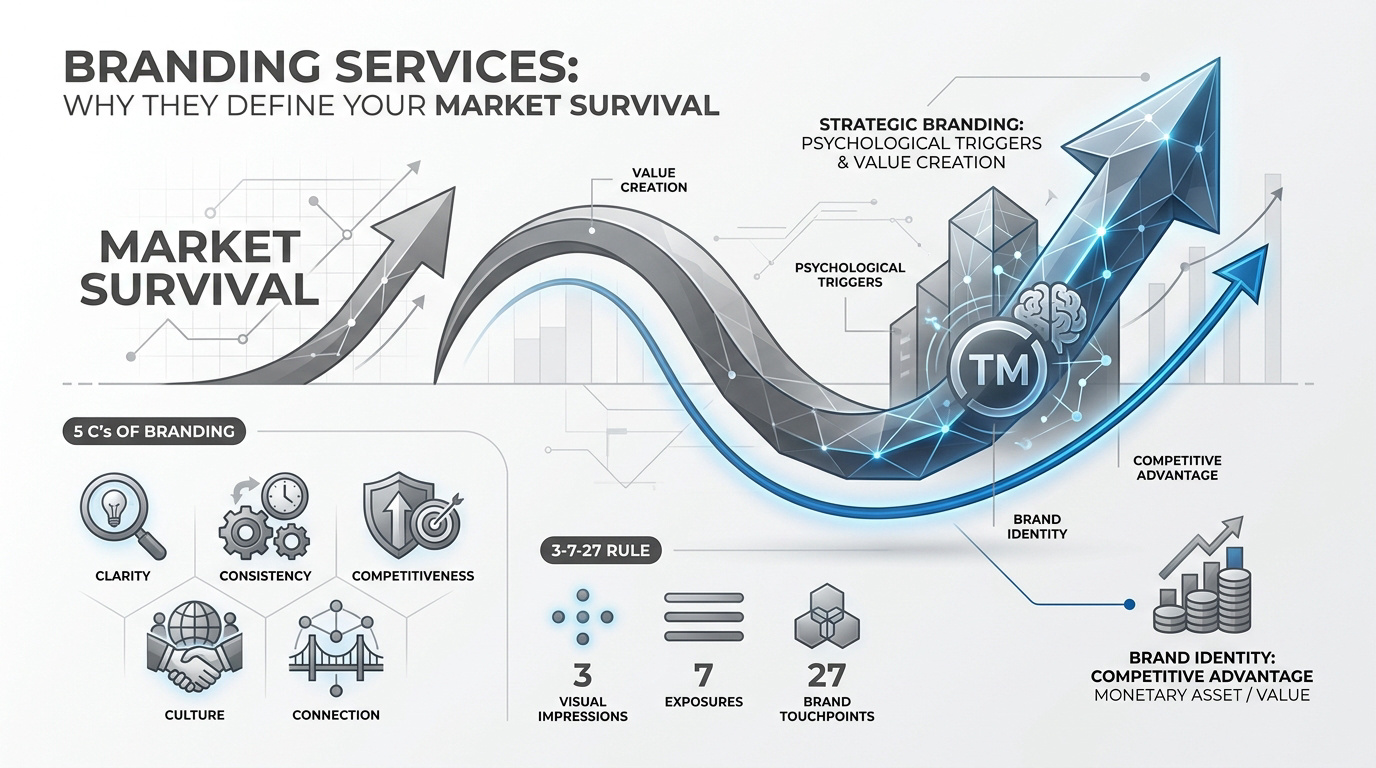
Strategic branding transforms logos into high-value monetary assets by securing trademarks and psychological consumer triggers. Success relies on the 3-7-27 rule and the 5 C’s, Clarity, Consistency, Competitiveness, Culture, and Connection, to ensure long-term market survival.
The focus on monetary assets and psychological triggers leads directly into how specific visual elements like typography and color palettes function.
Beyond the Logo: Creating a Visual Identity That Works
Typography and color palettes aren’t just aesthetic choices. They are tools to trigger specific psychological responses in your target audience. Consistency in these visual cues builds trust over time. Every touchpoint must feel familiar.
Professional design makes your business look established and reliable immediately. Check out Investopedia’s definition of branding to see how design confers a competitive advantage. It is about securing your market position effectively.
The Strategy That Keeps You From Being Just Another Name
Your strategic foundation and brand mission matter most. A brand is an idea worth rallying around for your customers and team. Effective branding strategy dictates how you communicate core values across every channel.
A brand is an intangible asset that impacts profits and shareholder value for listed companies.
Strategy ensures you don’t blend in. It carves out your specific niche effectively. Without it, you are just another name in a crowded market.
How the 4-Stage Project Process Actually Works
Moving from the “why” of strategy to the “how” of execution requires a disciplined, step-by-step roadmap to avoid common pitfalls.
From Discovery to Rollout: The Project Roadmap
The process begins with a discovery and strategic planning phase. Understanding the market is imperative before any design work starts. This step sets the tone for every future creative decision.
Next comes design and deployment. Execution requires total precision across all your physical and digital assets. This is where you face real branding challenges in the field.
Here is a summary of the journey:
- Discovery: Market research and audits
- Strategy: Positioning and messaging
- Design: Visual identity creation
- Rollout: Launch and asset management
Mastering the 3-7-27 Rule for Channel Consistency
Are you familiar with the 3-7-27 rule for your touchpoints? It takes three seconds to capture attention. Seven contacts create a memory. Twenty-seven contacts finally solidify loyalty to your brand. Consistency is your only tool here.
To catch attention
To create a memory
To solidify loyalty
Clear brand guidelines prevent any dilution of your identity. They ensure that every employee uses the same voice. Examine the difference between visual identity vs brand style guide to understand what is at stake.
Without strict rules, your image quickly becomes an unreadable mess. Consistency remains the hallmark of a professional business.
The 5 C’s That Make Small Business Branding Stick
While the process is universal, small businesses must focus on specific pillars to compete with larger, more established corporate entities.
Clarity and Connection Over Corporate Polish
Apply the 5 C’s: Clarity, Consistency, Competitiveness, Culture, and Connection. Small businesses win through authentic connection. They don’t need the cold, sterile polish of a massive global corporation.
| Feature | Small Business Focus | Corporate Focus |
|---|---|---|
| Messaging Style | Personal | Formal |
| Decision Speed | Fast | Slow |
| Customer Relationship | Direct | Layered |
Clarity means your audience knows exactly what you do. Connection means they actually care. Use your unique culture to stand out from the generic competition.
Differentiating Your Voice in a Crowded Market
Develop a unique brand voice and messaging framework. How you talk is as important as how you look. Your tone should reflect your values and resonate with your local market.

Local nuances can make or break a brand’s relevance. It is vital to understand geographical considerations and local market trends. Check out this B2B digital agency London for localized expertise.
History shows that branding isn’t just a modern trend. Artisans have used marks to distinguish goods for centuries, as noted in Investopedia’s insights on brand history. Use your voice to maintain that legacy.
Measuring ROI and Knowing When to Pivot
Creating a brand is an investment, not an expense, so you need clear ways to track its performance and know when it’s time for a change.
Hard Metrics for a Soft Asset
You must track your brand equity and customer loyalty with precision. Closely monitor repeat purchase rates and referral volumes. These figures concretely prove that your branding efforts are paying off.

Analyze how your image influences your market position and your ability to set premium prices. A strong brand allows you to charge more. Your customers then become much less price-sensitive, especially with high-performing SEO services.
Branding is a high-value asset that requires legal protection and constant management to remain profitable.
Red Flags That Signal You Need a Rebrand
Identify practical signs such as brand dilution or sudden market shifts. If your current look no longer reflects your services, you have a real problem. Do not wait to lose market share.
- Audience misalignment
- Outdated visuals
- Merger or acquisition
- New competitive threats
You must adapt or disappear. Even historic brands collapse if they refuse to evolve with the changing needs of their audience.
By mastering the 5 C’s and the 3-7-27 rule, you transform your identity into a high-value asset. Now, apply these strategic branding services to ensure your market survival and drive long-term loyalty. Consistency isn’t just a choice; it is your ultimate competitive advantage for the future.
FAQ
What exactly do branding services include for a business like mine?
Branding services are way more than just picking a pretty font or designing a logo. They represent a strategic approach designed to align your company’s vision with your communication and internal culture. It’s about creating a cohesive identity that acts as a high-value asset for your market survival.
In practice, this involves everything from market research and brand audits to defining your unique positioning and messaging. It’s about building a visual identity, like typography and color palettes, that triggers the right psychological responses and ensures you aren’t just another name in the crowd.
How long does it take for people to actually remember my brand?
It’s not an overnight thing, and that’s where the 3-7-27 rule comes in. You need three interactions just for someone to notice you, seven to start building real trust, and twenty-seven contacts to truly solidify brand loyalty and stay “top of mind.”
Consistency is your best friend here. By showing up with the same voice and visuals across all channels, you turn simple awareness into a reliable memory. Branding is a long game where repetition builds memorability and trust always precedes a transaction.
What are the core pillars of branding for a small business?
For a small business to compete with the big corporate giants, I always recommend focusing on the 5 C’s: Clarity, Consistency, Content, Connection, and Confidence. You don’t need a sterile corporate polish; you need an authentic connection that makes people care about what you do.
Clarity ensures your audience knows your mission instantly, while consistency builds the reliability needed for trust. By creating valuable content and fostering a real community, you leverage your agility advantage to stand out in a way that massive, slower corporations simply can’t.
How do I know if my investment in branding is actually paying off?
You can track the ROI of these “soft assets” by looking at hard metrics like Customer Acquisition Cost (CAC), referral numbers, and repeat purchase rates. A strong brand gives you pricing power, meaning you face less price sensitivity and can often charge more than generic competitors.
I also suggest monitoring your Brand Equity and Brand Lifetime Value (CLV). If your marketing efforts are generating higher margins and your customers keep coming back, your branding strategy is doing its job of transforming your identity into a profitable monetary asset.
When is the right time to consider a professional rebrand?
You should look out for red flags like audience misalignment or your visuals feeling outdated compared to current market trends. If your brand no longer reflects the services you offer or if you’ve gone through a merger, it’s time to pivot before you lose market share.
Remember, a brand is an intangible asset that requires constant management. If there’s a disconnect between your internal culture and your external message, or if new competitive threats are making you blend in, a strategic rebrand can provide the new perspective needed to fuel your next phase of growth.